
Introduction
Heat training can induce physiological adaptations that can lead to increases in performance. However, the way in which heat training is carried out has a big impact on whether these gains are realised. This article will discuss the types of heat training (passive vs active), how to fit heat training into your training plan, the specifics of a well-designed protocol, and some safety tips.
Passive Vs. Active Heat Training
There are two main types of heat training (HT), passive and active. Passive involves heat stress with no exercise, whilst active involves heat stress whilst exercising. In active HT, the exercise modality is usually in the athlete's target sport, although cross training is a viable option (e.g. runners can cycle during heat training).
Passive HT can take lots of different forms. Common examples are saunas, steam rooms, and water immersion (bath). The most effective are saunas (traditional are likely better than infrared) and hot water immersion (e.g. bath). The biggest advantage of passive HT compared to active HT is that it can provide a mental break and does not involve the same movement patterns as normal training. This can help reduce both physiological and psychological fatigue. Another benefit to passive HT is that the intensity of the stimulus (temperature) is much more controllable each time, making session to session comparison/progression much easier. The biggest disadvantage is that you either must purchase your own equipment or join a facility that provides a sauna (which may bring scheduling/travel issues).
By far the most practical and cheapest way of active HT is to do the sessions indoors with no fans, whilst wearing more clothing/heat suit. Many of the adaptations outlined in our previous article are systemic (e.g. plasma volume, haemoglobin mass, sweat rate), which means they will occur by both active HT and passive HT. However, some of the adaptations are modality specific (e.g. perceived exertion, glycogen preservation). It's plausible that the modality specific adaptations will be induced to a greater extent via active HT, compared to passive HT. This, and the fact that active HT is usually more accessible for most individuals, are the key advantages it has over passive HT. However, the lack of consistency in heat intensity due to the temperature being hard to control, may make the systemic adaptations (arguably the more important adaptations) less robust/harder to achieve. One way to get around this is to utilise core body temperature sensors (e.g. CORE Sensor). Although these have been shown to not be accurate in measuring core body temperature, they have been shown to be reliable (gives consistent readings) [1]. This means that although the specific value may be inaccurate, the rises and falls in core body temperature should still be useful. The “Heat Strain Index” and “Heat Zones” are limited by the validity of the underlying measurements, so it's better suited for tracking trends rather than relying on absolute strain zones. It's especially important from a safety point of view to not rely on this data to control your session's intensity and duration (See Safety section for more information).
Overall, passive HT is our first recommendation due to the stress relief benefits, less risk of mental burn out, superior heat intensity control. In our opinion, it is especially superior to active HT in circumstances where you want to maintain heat acclimatisation for a prolonged period (1+ months or indefinitely). Active HT gives a practical alternative, that can be utilised for infrequent acclimitisation (e.g. for a one-off target event a few times per year). Of course, you can also mix the two options which may provide nice variation.
Heat Training Protocols
Much of the thought process behind designing these protocols comes from our previous article on the current scientific literature of HT. If you want more depth, please check this article out. Additionally, the adaptations can be found in this other article.
Safety
Heat stress can be very dangerous if not respected. Although it has a high stress on the body, it is not a good idea to go into it the same way you would a high intensity session. Therefore, you should not try and “push through” any warning signs. As mentioned in previous articles, adaptations are more linked to the duration rather than the intensity of heat stimulus, so if the temperature is too high to complete the desired duration, it needs to be lowered.
- Early Warning Symptoms: Excessive fatigue/weakness, dizziness/nausea, headache, rapid heart rate (heat stress will increase heart rate, but it should not be abnormally high).
- More concerning: Confusion, vomiting, chills, pale skin.
If using a CORE body sensor, this is the order of which variables should dictate whether you're over doing the intensity or duration.
- RPE/Symptoms: Most important.
- Heart Rate: Very important, abnormally high is a warning.
- Change in core body temperature: Less important.
- Heat Strain Index: Least important but supports the above.
Hydration: Fluid, Sodium and Carbohydrate intake
Here are our general recommendations. You can adjust them based on your individual sweat rate and content. Carbohydrate intake is important as it enhances water uptake compared to plain water [2]. It does this because one of the transporters in the small intestine, sodium-dependent-glucose-1 (SGLT1), must move sodium with glucose to work. When sodium enters the cells, water follows osmotically.
- Pre:
- You should be hydrated well (clear urine) in the hours leading up to the HT session.
- Glycogen stores should be topped up.
- If you are training directly before the HT session, you could add ~100 mg of sodium per hour on top of your usual training intake (usually 300-800 mg/hr), and an additional ~20 mg potassium per hour (usually 60-160 mg/hr, or 20% of sodium intake).
- It is highly recommended to not do an unfueled session (if greater than 30 mins) directly before the HT session.
- If passive HT with no session directly before, you can add 100-200 mg sodium to “during drink” (listed below), and start sipping it 30 mins before you begin.
- During:
- Some level of dehydration is likely needed for the induction of some of the adaptations. Therefore, water and electrolyte intake during the session can be kept quite low. Passive HT sessions can have intakes as low as zero, however, for active HT (particularly when following other training), you should follow usual ride intakes:
- Water: 0-1000 ml/hr (adjust to sweat rate). TIP: You should not be losing more than 4% bodyweight from directly before till directly after the HT session.
- Sodium: 0-700 mg/hr if trained directly before, 0-500 mg if no training before.
- Potassium: 20% of sodium intake.
- Carbohydrates: This needs to include glucose, (fructose powder on its own will not increase water uptake)
- Active HT: 30-60g/hr on top of what you would normally have for whatever watts you will be riding at (use our fueling calculator here).
- Passive HT with no training before: 0-30g/hr.
- Passive HT with training before: 30-100g/hr (You can start the muscle glycogen recovery process for your normal training session)
- Some level of dehydration is likely needed for the induction of some of the adaptations. Therefore, water and electrolyte intake during the session can be kept quite low. Passive HT sessions can have intakes as low as zero, however, for active HT (particularly when following other training), you should follow usual ride intakes:
- Post:
- Water: Drink 125% of bodyweight lost, split into this:
- 0-30 mins after: 50 % of bodyweight lost with 200-500 mg sodium (+ 20% potassium), with 15-50 g sugar.
- 30-120 mins after: Remaining bodyweight weight lost replaced.
- Electrolytes: May need to add extra salt to meals following the session. Headaches in the hours following a HT session can indicate this.
- TIP: Do not intake all these fluids at once after completing the heat training. This can result in vomiting and nausea, as stomach emptying has been slowed by the core body temperature rise. Instead, 250ml initially and then small sips thereafter is the best approach.
- Water: Drink 125% of bodyweight lost, split into this:
Initial Phase
The initial phase is the most crucial as all sessions MUST be done on consecutive days. The recommended duration of this period is 14 days. The absolute minimum should be 10 days (See the acclimatisation section for exceptions to this rule). The duration of each individual session will depend on the temperature/athlete variation at handling heat, but a rough guide per session can be found in Table 1 below. It is very common to not be able to reach the target time in the first few sessions, especially in a public sauna where temperature control is not up to yourself. If this is the case, abort the session at whatever duration it starts to become uncomfortable.
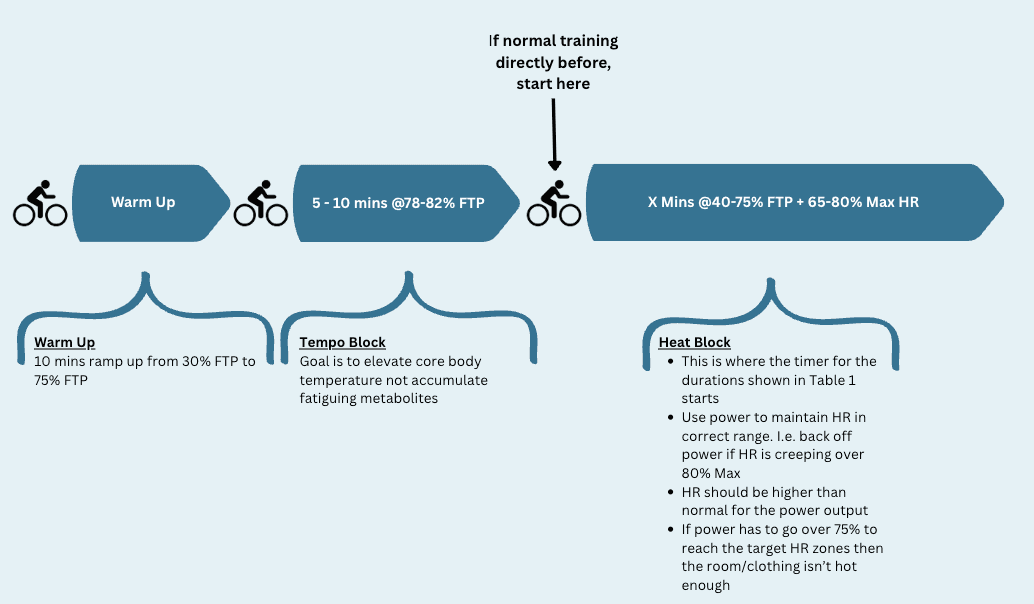
Table 1: Proposed durations for each session in the initial phase based on different HT methods. If you have a normal training session directly before the HT session, then the duration is reduced since core body temperature will already be slightly elevated. Passive HT below is 70-90 °C dry traditional sauna. These are not hard values, just rough guidelines. See Figure 1 to see when the timer begins during active HT sessions.
| DAY | Passive HT + Training directly before | Passive Heat Training | Active HT + Training directly before | Active HT |
|---|---|---|---|---|
| 1 | 10-15 Mins | 15 Mins | 15-20 Mins | 25 Mins |
| 2 | 10-15 Mins | 15 Mins | 20 Mins | 30 Mins |
| 3 | 15 Mins | 15-20 Mins | 20 Mins | 30 Mins |
| 4 | 15 Mins | 20 Mins | 25 Mins | 30 Mins |
| 5 | 15-20 Mins | 20 Mins | 25-30 Mins | 30 Mins |
| 6 | 20 Mins | 20-25 Mins | 25-30 Mins | 35 Mins |
| 7 | 20 Mins | 20-25 Mins | 30 Mins | 35 Mins |
| 8 | 20 Mins | 25 Mins (Can be split into 2 reps with 5 mins between each) | 30 Mins | 30-40 Mins |
| 9 | 20-25 Mins | 30 Mins (Can be split into 2 reps with 5 mins between each) | 30 Mins | 30-40 Mins |
| 10 | 20-25 Mins (Higher end can be split into 2 reps with 5 mins between each) | 30 Mins (Can be split into 2 reps with 5 mins between each) | 30 Mins | 30-45 Mins |
| 11 | 20-30 Mins (Higher end can be split into 2 reps with 5 mins between each) | 30-40 Mins (Can be split into 2 reps with 5 mins between each) | 35 Mins | 30-45 Mins |
| 12 | 20-30 Mins (Higher end can be split into 2 reps with 5 mins between each) | 30-45 Mins (Can be split into 2 reps with 5 mins between each) | 40 Mins | 30-60 Mins |
| 13 | 20-30 Mins (Higher end can be split into 2 reps with 5 mins between each) | 30-45 Mins (Can be split into 2 reps with 5 mins between each) | 45 Mins | 30-60 Mins |
| 14 | 20-30 Mins (Higher end can be split into 2 reps with 5 mins between each) | 30-45 Mins (Can be split into 2 reps with 5 mins between each) | 45 Mins | 30-60 Mins |
Maintenance Phase
The maintenance phase helps you keep hold of the adaptations you have gained from the initial phase. The frequency needed to maintain the adaptations is much lower than the frequency needed to gain them in the first place. Therefore, you can continue normal training load alongside this phase. More information can be found our article here. Here are some tips for the maintenance phase:
- You do not need to continue to push duration. You can cap all HT sessions at 30 minutes, regardless of the method used. Alternatively, you can do the duration that you were able to do on the 14th day of the initial phase.
- Minimum frequency is 2x per week, optimal is 3x per week. A good option is 2x per week for most of this phase then move to 3x per week for
- If you're opting for active HT sessions during the maintenance phase, we recommend to not have the HT as it's own session, but instead stick it on the end of another ride (e.g. come back from endurance or interval session, put heat suit/clothes on, HT session indoors).
- If you really enjoy HT, have easy access to it, and are interested in maximising the haemoglobin benefits, then you can do 4-6x per week in the maintenance phase.
Macrocycle Placement and Reacclimitisation Phase
Macrocycle placement (the position within a long-term plan, e.g. 1 year training plan) for the initial phase is very important. As the initial phase is made up of consecutive high stress days, we recommend limiting high intensity training in at least the first 5 days (ideally 7 days). By the 5th day, your body's response to heat should be much less aggressive (won't trigger such a high sympathetic response). Additionally, during the initial phase, overall training volume should be reduced by the duration of the HT sessions (if passive) and by half the duration of the HT sessions (if active).
Example 1:
- Athlete with a high priority event in July but also wants to benefit from the heat adaptations across the whole season. The first event (low priority) is in April. They have access to a sauna.
- The initial phase will begin in February.
- Before the initial phase, the athlete's training is around 15 hours per week with 2 interval sessions. Tip: A small deload (~ 3-5 days reduced training load) leading into the initial phase is sometimes beneficial, depending on how much fatigue the athlete currently has.
- The initial phase will be an average of 30 mins passive HT per day for 14 consecutive days (following Table 1).
- The athlete's training volume (excluding HT) for the first week is 11.5 hours (15 - (7 x 0.5)), and they will not do any interval sessions during this week.
- In the second week of the initial phase the athlete's training volume remains at 11.5 hours, but normal interval sessions are resumed.
- After the initial phase, the maintenance phase starts immediately. Training volume is raised back to pre-initial phase levels (~ 15 hours).
- The maintenance phase involves a 30-minute passive heat session twice a week, directly after a training ride or gym session. They are separated equally within the week.
- The athlete can increase maintenance phase frequency to 3x HT sessions per week in the month leading up to the target event in July, but it is not strictly necessary.
As mentioned in our previous article, heat training reacclimitisation is 8-12 times faster than initial acclimitisation. This allows for interesting programming around tapering for key events. It also gives the option to athletes who only want to use heat training for a specific event. They do not want to undergo months of maintenance but also want to limit the interference of heat stress near their target event (during taper period).
Example 2:
- Athlete with a high priority event in July. Does not want to carry out maintenance phase throughout the whole season. They do not have access to a sauna.
- The initial phase will begin in April or May (depending on event schedule).
- Before the initial phase, the athlete's training is around 15 hours per week with 2 interval sessions. Tip: A small deload (~ 3-5 days reduced training load) leading into the initial phase is sometimes beneficial, depending on how much fatigue the athlete currently has.
- The initial phase will be an average of 40 mins active HT (with normal training directly before) per day for 14 consecutive days (following Table 1).
- The athlete's training volume (including HT) for the first week is 13.25 hours (15 - ((7 x 0.5)/2)), and they will not do any interval sessions during this week.
- In the second week of the initial phase the athlete's training volume remains at 13.25 hours, but normal interval sessions are resumed.
- After the initial phase, there is no maintenance phase (0 HT sessions per week). Training volume is raised back to pre-initial phase levels (~ 15 hours).
- 2-3 weeks before the target event the athlete undergoes a reacclimitisation phase of 5-7 consecutive active HT sessions (30-45mins). Athlete's current training volume and intensity is maintained throughout this period.
- After this, the athlete does 2-3 active HT sessions per week, with the final one being 3 days before the event.
- In this example, if the athlete had done the initial phase 2-3 weeks before the target event, it would have disrupted training leading into the event and likely incurred too much fatigue. The approach outlined maximizes heat adaptations on the day of the event whilst minimising fatigue.
Summary
Overall, passive HT is superior to active HT, due to the stress relief benefits, less risk of burnout, and greater controllability. Active HT gives a practical alternative and may provide greater modality-specific adaptations. Safety during HT is not to be taken lightly, and you should prioritise RPE/symptoms over other metrics. Hydration impacts the recovery and efficacy of a heat session. The important components of hydration are water, carbohydrates, sodium, and potassium intake. The most important parts of the initial phase are HT on consecutive days, and the total number of days. Maintenance and reacclimitsation phases can be adjusted or removed completely depending on the individual's goals and routine.
References
- Verdel, N., Podlogar, T., Ciuha, U., Holmberg, H.-C., Debevec, T. and Supej, M. (2021). Reliability and Validity of the CORE Sensor to Assess Core Body Temperature during Cycling Exercise. Sensors, 21(17), p.5932. doi:https://doi.org/10.3390/s21175932.
- Jeukendrup, A.E. (2017). Training the Gut for Athletes. Sports Medicine, 47(S1), pp.101-110. doi:https://doi.org/10.1007/s40279-017-0690-6.